How to build B2G pipeline without adding headcount
How govtech and edtech teams grow qualified B2G pipeline with the reps they have, by automating account research and scoring public buying evidence.

Your pipeline target went up, but your headcount can’t. So the first question is not who to hire. It is where your current reps are spending time that does not create pipeline.
This guide shows where those hours go in government and education selling, which parts of that account research you can hand off to software, which parts still require a rep, and how to measure the change in pipeline generated per rep.
How do you build B2G pipeline without adding headcount?
You build B2G pipeline without adding headcount by handing the hottest accounts to your reps using software based on budget, timing, and need.
Where B2G sales reps lose their selling hours
The strategies below apply specifically to State, Local, and Education (SLED) sales rather than federal contracting, which follows a different procurement motion.
In SLED, non-selling hours often go into finding and refreshing public records across separate government and education websites.
Reps often collect board minutes, adopted budgets, and contract dates account by account.
Across school district and city accounts, reps repeat the same lookups:
- Open the district’s board portal to see whether the last meeting mentioned a budget line for your category
- Search the district or city site for the current director of technology, because the name in the CRM may predate the last leadership change
- Find the adopted budget to confirm that a dollar figure exists
- Check when the incumbent vendor’s contract runs out
None of that work produces a durable answer.
Boards meet again on their next cycle, budgets get adopted again next year, and the director of technology can move to another district.
Each of those events resets the research, so a rep who wants a current picture runs the same lookups again.
Automating government account research without removing rep judgment
Automate recurring lookups that return a specific contact, a budget figure, or a contract date. The rep keeps making every decision that depends on knowing your product, your pricing, and the buyer.
Software can run those lookups across a territory and refresh the answers on a schedule without a rep asking again.
The rep still judges whether the budget line covers what you sell, whether the new technology director is a champion or a blocker, and whether a district that discussed your category deserves a call this quarter.
To answer lookups like these, the system collects the underlying minutes and budget documents, filters them for mentions of your category, and attaches the relevant excerpt to the account so the rep can judge fit instead of hunting for the record.
That’s one of the reasons we created Starbridge.
Starbridge is the AI GTM platform for companies selling to the government, K-12, and higher education, helping teams prioritize the right accounts, engage the right people earlier, and identify high-intent opportunities before the competition.

Starbridge monitors board meeting minutes, budget documents, and contract records across 320,000+ government and education entities, then assembles the account context a rep would otherwise collect by hand.
After replacing that manual collection work with Starbridge, Frontline Education cut account research time by 90%, and its sellers now spend meeting time on solution conversations instead of basic discovery.
Keeping government and education contact data current without SDR hours
Government and education contact records go out of date as officials change roles, so put CRM enrichment on a fixed schedule and stop rebuilding the contact list before each campaign.
The ILO Group’s Superintendent Research Project found that 114 of the 500 largest school districts, or 23%, changed superintendents in the year before its September 2025 report, up from 20% a year earlier and above the pre-pandemic range of 14% to 16%.
Leadership changes can reshape the entire cabinet, so the assistant superintendent, technology director, and business official sitting in your CRM may also change roles.
Because officials continue changing roles during and after a campaign, a manually rebuilt list loses accuracy over time. Without scheduled refreshes, teams discover staleness one bounce at a time while the rest of the list stays unchecked.
A re-verification pass checks each CRM contact record and writes the current title and contact method back to the account.
Starbridge keeps government and education contact data current in Salesforce and HubSpot with continuously verified contact records that sync automatically into the account.

Mantra Health tripled its data enrichment coverage with Starbridge, enriching more than 3,000 accounts in its CRM without a technical Salesforce admin, according to Andrew Conley, Senior Sales Operations Manager.
An account scoring and alerting motion for a B2G team
A small team can scale coverage by ranking accounts based on public evidence of budget, timing, and need, then alerting a rep only when an account crosses a scoring threshold.
The early buying indicators that move an account’s score
These public records can move an account up the list before an RFP is published:
- Board and council meeting minutes that discuss the problem your product solves
- Proposed budgets, adopted budgets and capital plans that fund the category
- Contract expirations that put an incumbent vendor’s renewal in play
- Grant awards that attach new money to a specific program
Meeting minutes tell you the buyer has identified the problem, and budget documents and grant awards tell you the money exists. Contract dates indicate the window in which the renewal-or-rebid decision is made.
For guidance on how to weigh these records against each other, read our guide to ranking pre-RFP buying intent.
How to set your matching criteria
Start by defining which signals are actually useful to your reps.
Work with the team to identify the events they want to see, the ones they do not, and how recent a signal needs to be before it is worth acting on.
The goal is for every account entering the queue to have a current, specific reason for outreach.
Then tune the criteria so the number of qualifying accounts matches what the rep can realistically work. If too many low-value accounts surface, tighten the criteria. If the queue is consistently empty, broaden them.
Starbridge works with your team to define the signals that matter, filters out the ones that do not, and scores accounts against those criteria as new records appear. Qualifying changes are then delivered by email or CRM with the underlying buying signal attached.
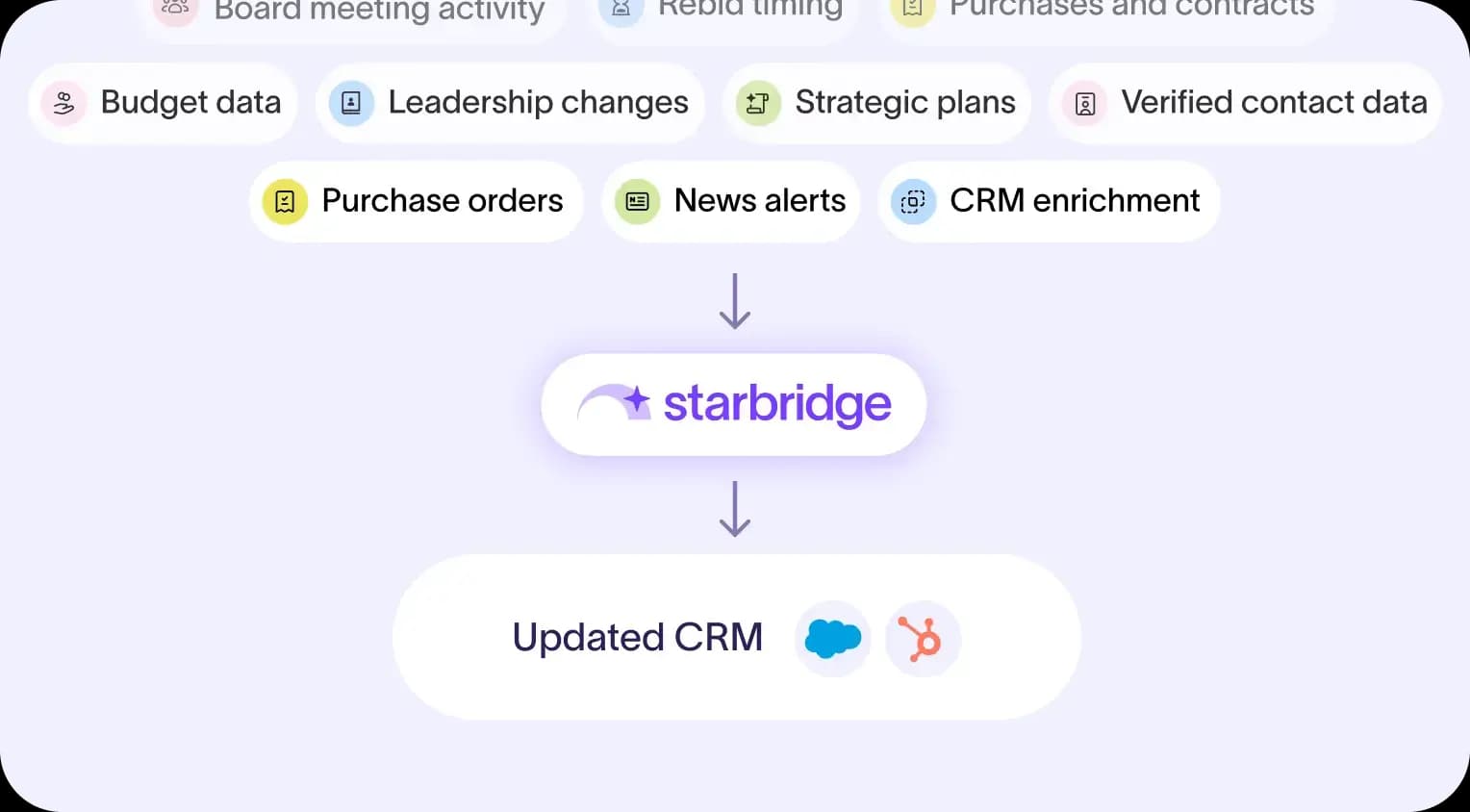
InquirED reports $200K in new pipeline in its first quarter after replacing manual board-document research with signal-driven account scoring.
How do you measure B2G pipeline output per rep?
Measure qualified opportunities created per rep per quarter, pipeline dollars created per rep, and research hours per opportunity.
Calls placed and emails sent are workload measures. They do not show how much pipeline the team produces.
The Bridge Group’s 2025 SDR report covers activity and pipeline metrics from 351 B2B companies. It puts median daily activity at 112 touches per rep and says only 60% of SDRs hit quota.
These figures provide useful workload context, but activity alone does not measure pipeline.
The report also records median pipeline sourced per SDR at $3.78M a year and says higher average selling prices drove the rise from its prior report. Pipeline dollars per rep can therefore increase even when opportunity count does not.
So here’s how to measure B2G pipeline output:
- Track opportunity count alongside pipeline dollars so forecasting changes are not recorded as a productivity win.
Baseline the numbers before you change the motion.
- Record qualified opportunities per rep per quarter
- Calls and emails made, which should be used as supporting context for time spent researching accounts
- Outbound email quality - this one is qualitative
- Re-measure one quarter later.
If research hours per opportunity fell while opportunity count held or rose, that is a signal that recovered capacity is showing up as pipeline.
If opportunity count fell, check whether reps worked the ranked accounts before changing the evidence behind the score.
Conclusion
The first place to look for more qualified pipeline is by increasing your current reps’ effectiveness. Look at the time your reps now spend collecting information that a system could collect for them.
Start with measurement. For two weeks, separate each rep’s research hours from outreach hours and count the accounts each rep reaches.
Then automate the lookups your reps repeat on every account, schedule contact enrichment, and rank accounts using public evidence of budget, timing, and need. Each rep gets a queue sized to the accounts they can work.
Use opportunities per rep and research hours per opportunity as the core measures. Treat call counts as a diagnostic.
Book a demo to see what your reps could stop doing manually.
Frequently asked questions
No fixed account count applies because coverage depends on the time each account requires and the hours a rep has available. Divide the weekly hours a rep can spend on accounts by the combined research and outreach time each account requires. When a system delivers ranked accounts with evidence and verified contacts attached, that per-account time should fall.
Manual research time varies with the number of sources a rep must open. One district or city account can require the board portal, adopted budget, staff directory, and procurement page, each with a separate search. Time one rep across five accounts to establish your team’s baseline.
We don’t recommend using AI agents to replace an SDR or a B2G sales team. Software can run recurring lookups, refresh contact data, and rank accounts on public evidence. Deciding whether an account deserves a call and what to say still requires a person who understands the product, pricing, and buyer.
Only surface signals that give the rep a current, specific reason to act. Work with reps to define which events are useful, which create noise, and how recent the evidence needs to be. If alerts are being ignored, review the ones reps skipped and remove or tighten the signal types that repeatedly fail to produce actionable outreach.
New pipeline can appear within the first quarter, while closed revenue takes longer. For example, InquirED reported $200K in new pipeline in its first quarter after moving to signal-driven account scoring. Government and education purchases remain tied to budget and procurement calendars.
Explore our use case library
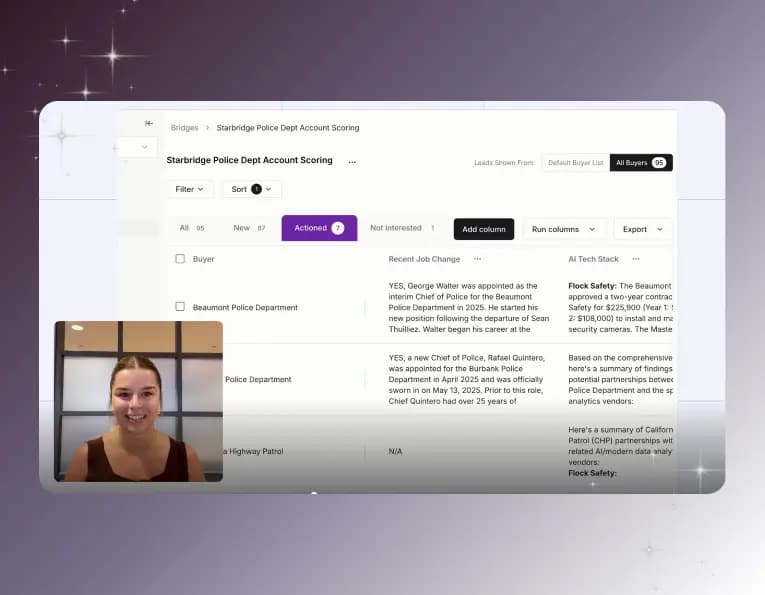 Automate account research with AI agentsStop manually researching accounts. Starbridge AI agents automate account research by monitoring buying signals 24/7 and surfacing the right contacts.
 Identify competitor contract expiration datesThe RFP is usually a formality. Starbridge surfaces competitor contract expiration dates so your reps reach accounts before the renewal cycle closes.
 Create a conference campaignTurn conference badge scans into pipeline. Import your contact list, surface buying signals across every account you met, and follow up with context.