How to outbound competitor contract expirations and displace incumbents before the RFP
A competitor's contract expiration is a date on a calendar. Here is when to start outbound, who to contact at each stage, and what the message should say.

A competitor’s contract with a school district or city has an end date, and that date is public information. Most sellers discover that date only after the RFP, when the buyer has already decided what to do next.
This guide explains when to begin outbound efforts against a competitor’s expiring contract, who to contact at each stage, and what each message should say.
How do you run outbound off a competitor’s contract expiration?
Competitor contract expiration outbound uses a rival vendor’s contract end date, sourced from public records, as the trigger for timed outreach. Reps engage 12 to 18 months before the end date, while the buyer is still deciding whether to renew, so the conversation happens before requirements are written.
Where competitor contract expiration and renewal dates surface in public records
Competitor contract expiration dates are rarely stored in one place, so finding them usually means piecing together several public records, and looking at the overall context.
- Award notices on state and local procurement portals name the winning vendor, contract value, and term. An award posted today describes a contract ending three to five years from now, which is what makes portal monitoring worth the effort.
- Contracts and purchase orders obtained through public records requests are the most complete source. The agreement itself specifies the end date, the renewal structure, and any opt-out clause. Requests take time to be fulfilled, so submit them well before you need the answer.
- Board and council agenda packets capture decisions that never reach a bid board. Renewals above a local approval threshold go to a public vote, and the supporting documents name the vendor, the amount, and the term. A district approving a one-year renewal instead of its usual three-year term is telling you something.
- Purchase order history fills the gaps. When no end date is published anywhere, the date of the first payment to a vendor plus the standard contract term for that category produces an inferred renewal window. That window is accurate enough to rank accounts by how close they are to renewal.
Each source has its own extraction method, covered in the guide to finding expiring government contracts.
When to start outbound ahead of a contract renewal window
Do not wait until a competitor’s contract is about to expire to start outreach. By then, the agency may have already decided whether to renew the incumbent, rebid the contract, or allocate budget for the purchase.
Some of the earliest buying signals are budget requests.
Most cities begin working on the next fiscal year’s budget several months before the fiscal year starts, and the Georgia Municipal Association’s sample municipal calendar has departments returning budget request forms to the budget officer in mid-April for a July 1 start. A contract ending June 30 is funded, or left unfunded, in a request written the previous winter.
The renewal decision is another factor to look out for, because an expiring contract does not automatically become a competition. If the buyer renews, the window closed months earlier without ever appearing on a portal.
Market research is the final factor, and the only one that formally invites a challenger in. During market research, the buyer asks vendors what is possible, and the answers shape what the eventual solicitation requests.
Working backward from those gates puts the first touch 12 to 18 months out.
Six to 12 months out, budget planning is underway and evaluation criteria are taking shape. Within six months, the path is usually set, which is why pre-RFP engagement is measured in quarters rather than weeks.
Who to contact at each stage of the renewal window
Government and education purchases usually involve several people, and the right contact changes as the contract moves closer to renewal.
Start with the end user.
A curriculum director, department head, or principal works with the incumbent product daily and knows where it falls short.
They rarely control the budget, and they are the person most likely to answer a first email 18 months out because nothing is at stake for them yet. In districts under 5,000 students, the superintendent often serves as both end user and economic buyer, which shortens the sales cycle.
Next, involve the economic buyer when budget planning begins.
A CFO, deputy superintendent, city manager, or similar executive helps decide whether money will be set aside for the product in the next fiscal year. Reaching this person before the budget is finalized gives a challenger a chance to make sure the replacement is financially possible before procurement begins.
In K-12 buying committees, the IT evaluator often holds the deciding vote.
When a product involves student data, the CTO or IT director can veto the purchase outright. So remember to address security and integration questions early.
Focus on procurement once the organization starts deciding how it will buy.
Procurement staff may conduct market research, issue an RFI, or determine whether the purchase requires a new competitive solicitation.
They generally do not choose which product the department prefers, but they do determine the purchasing route, including whether the agency can use an existing cooperative contract instead of running a new RFP.
Multi-thread in the above order:
- Start with the end user who has the problem.
- Add the economic buyer when the money moves.
- Bring IT in before anyone asks.
- Reach procurement when the buying process starts.
What an outbound message should say while the incumbent is still in place
How directly you reference the incumbent depends on what you actually know about the contract.
If you have a verified contract end date, renewal window, or subscription term, the contract itself can be the reason for reaching out. A rep can say that they know the agency’s current agreement with a specific vendor is approaching renewal and ask whether the team is evaluating its options.
If you only know that the account uses a competitor, but do not know when the contract ends or what it costs, treat that information as an account-prioritization signal rather than the opening line. In that case, lead with the buyer’s problem and other evidence that the timing may be right.
For example:
- Mention a nearby district that solved the same problem in a different way.
- Highlight a capability that did not exist when the original contract was signed.
- Ask how the current setup is holding up against a goal named in their own strategic plan.
- Combine incumbent data with signals such as new funding, leadership changes, budget activity, or a related initiative.
Government and education buyers respond well to results from a comparable entity nearby.
Remember to keep the ask proportionate to the stage:
- Eighteen months out, the ask is a 20-minute conversation about how peer districts are handling the problem.
- Closer to the budget request, the ask is a pricing conversation the buyer can include in a request.
Expect and answer the ‘locked-in’ objection
“We are locked in until June” is stating an objective timeline. Don’t treat it like a rejection.
Accept the timeline and ask for a smaller commitment within it:
- A paid pilot with defined success criteria.
- A briefing for the team that will write the next set of requirements.
- A place on the invitation list when market research opens.
Each of those requests is easier to approve than switching vendors mid-contract, and each one puts you inside the process before the solicitation exists.
Turning expiration dates into a repeatable outbound motion
A single contract expiration can create an opportunity. Tracking expiration dates across an entire territory turns that opportunity into a repeatable sales motion.
Start by scoring the accounts you already have.
An incumbent contract ending within 12 months moves an account to the top of the list.
A competitor that just signed a multi-year deal moves it to the bottom, worth a light nurture and nothing more. Ranking a territory by renewal proximity tells every rep which accounts deserve attention this quarter.
Then route the date into the rep’s daily workflow.
An expiration that arrives as a spreadsheet row gets worked once and forgotten. An expiration that arrives in the sequencer as a task, with the incumbent named, the verified contact attached, and the reason to reach out written down, gets worked on schedule.
Measure the motion by the outcomes that matter.
Track meetings booked from expiration-triggered outreach and, importantly, how far ahead of the renewal date those meetings occur. A high reply rate means little if the conversation starts after the buyer has already decided to renew.
This manual approach often breaks at scale. Tracking every award notice, renewal vote, and budget discussion across a few hundred accounts is work no team consistently does by hand.
That’s one of the reasons we created Starbridge.
Starbridge is the AI GTM platform for companies selling to the government, K-12, and higher education, helping teams prioritize the right accounts, engage the right people earlier, and identify high-intent opportunities before the competition.
The Buying Signals Monitor watches contract expirations, board meeting minutes, and budget discussions across state and local government, K-12, and higher ed, then pushes each one into the sequencer your reps already use, with the contact and context attached.
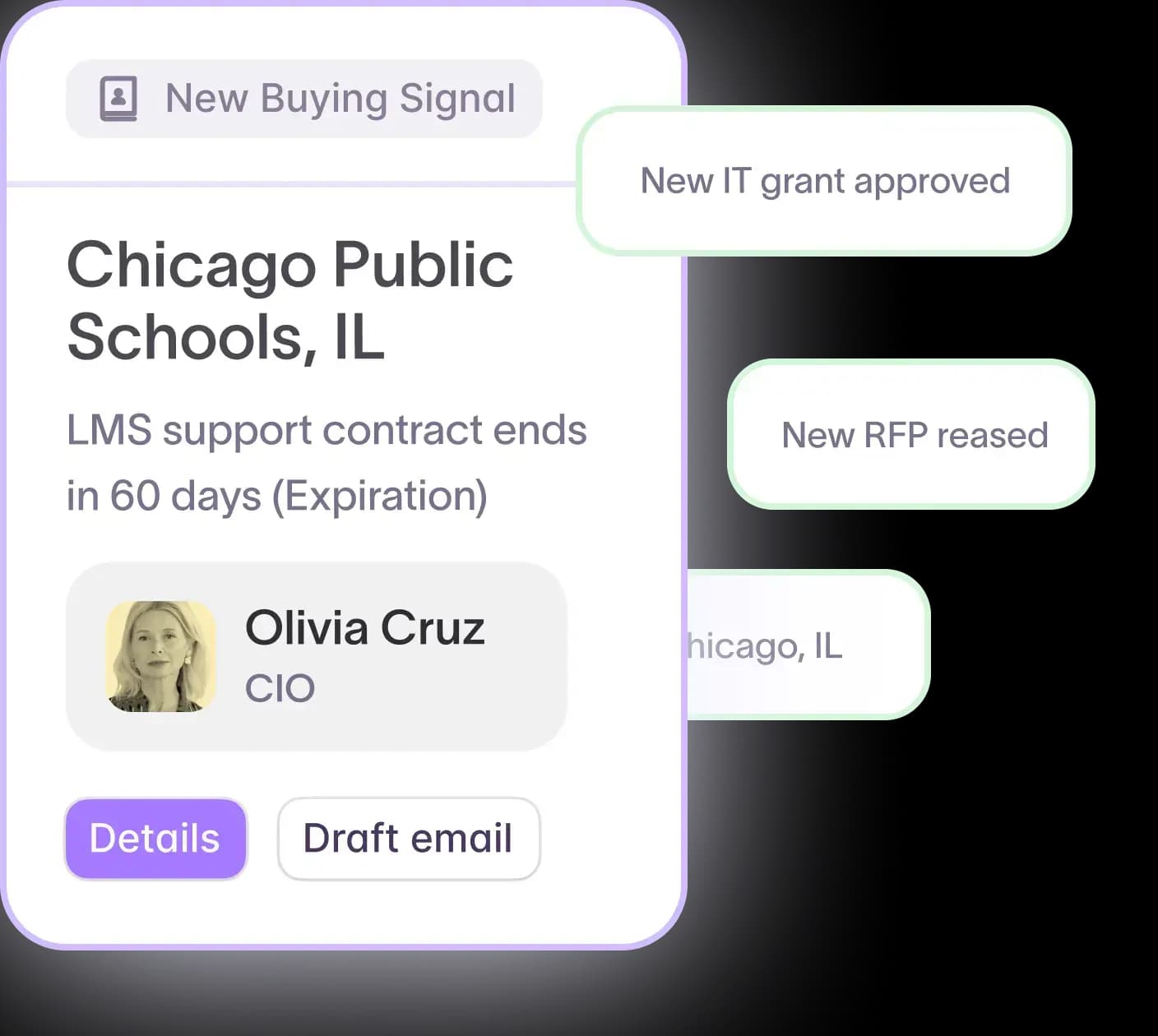
GovWell sources 15% of total qualified pipeline from Starbridge and booked five meetings in their first week, working contract expirations as a standing channel rather than a one-off campaign.
Where to start with your own territory
A competitor’s contract end date is one of the few buying indicators in government and education that comes with a specific date attached. The real value lies in what the buyer decides during the year leading up to that date.
Take your top 100 accounts. Identify the incumbent, find or infer the end date, and move the first touch 12 to 18 months ahead of it. Reach the end user first, the economic buyer as the budget request takes shape, and procurement when market research opens.
If you want your entire TAM covered instead of 100-something accounts, book a demo and see which contracts in your market are already inside the window.
Frequently asked questions
Treat that answer as a timeline rather than a rejection. Ask when the agreement ends and whether it renews automatically, then request something smaller than a vendor switch, such as a paid pilot with defined success criteria.
An account that just signed a multi-year deal belongs at the bottom of a ranked list. Log the end date, stay visible with useful material once or twice a year, and move the account up roughly 18 months before renewal.
Rarely on a first touch. Naming the incumbent signals that you researched the account before earning a conversation. Refer to the underlying problem the product of the incumbent was bought to solve instead.
Track meetings booked from expiration-triggered outreach and the average lead time between the first meeting and the contract end date. Lead time matters most. Replies arriving 90 days before expiration are bid invitations rather than opportunities for early influence.
A posted bid means the requirements are written and an incumbent likely shaped them. Expiration outbound begins while the buyer is still deciding whether to renew. If the buyer renews, the contract continues through an amendment and no solicitation is ever posted.
Explore our use case library
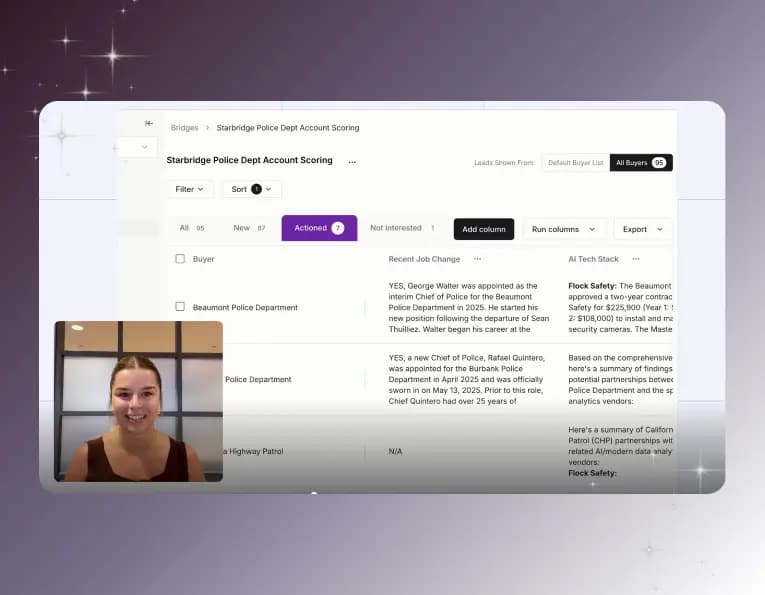 Automate account research with AI agentsStop manually researching accounts. Starbridge AI agents automate account research by monitoring buying signals 24/7 and surfacing the right contacts.
 Identify competitor contract expiration datesThe RFP is usually a formality. Starbridge surfaces competitor contract expiration dates so your reps reach accounts before the renewal cycle closes.
 Create a conference campaignTurn conference badge scans into pipeline. Import your contact list, surface buying signals across every account you met, and follow up with context.