How to respond to a government RFP
Learn how to respond to a government RFP, from the bid/no-bid call to evaluation criteria and compliance, with a scorecard your team can use this week.

A winning government RFP response starts before you write a word. For teams selling to local government, K–12, and higher education, the work begins with spotting buying signals, deciding whether to bid, and understanding what the evaluator will score.
TL;DR: Responding to a government RFP
To respond to a government RFP, first decide whether the opportunity is worth bidding on. Then map the evaluation criteria, follow the required format, and support your answers with evidence and clear pricing. Check every compliance requirement and amendment, submit before the deadline, and request a debrief. Early buyer research improves your position before writing begins.
Learn how government RFPs work before one drops
An RFP marks a formal solicitation stage in a buying process that started months earlier inside the district, city, or university. By the time the document posts, the buyer has assessed the need, identified a budget or funding plan, and often talked to vendors about what’s possible. Knowing that sequence tells you where your effort still pays off and where you’ve arrived too late.
RFP, RFI, and RFQ in state and local government and education
Common solicitation types indicate different stages of readiness:
- An RFP (request for proposal) asks vendors to propose a solution and price, with proposals scored on several criteria
- An RFI (request for information) gathers input while the buyer is still researching options
- An RFQ (request for quotation) compares prices for goods or services with a defined scope. Some buyers use RFQ to mean request for qualifications, so check the full title
A public RFP runs on stricter rules than a private one. Deadlines are fixed, evaluation follows the published criteria, and awards become public record. Federal procurement rules also generally require public notice and competitive bidding, with limited exceptions.
The RFP process follows a predictable order:
- Needs assessment and budget approval
- Release and the question period
- Evaluation and award
Many purchases never reach step two.
Buyers may use informal purchasing below the applicable competitive-bidding threshold, which varies by jurisdiction and funding source. Sole-source purchases require a separate justification. A cooperative contract that was already competitively bid can offer another route when the buyer, purchase, and funding source qualify.
Early buying signals that show an RFP is coming
Buyers in government and education are rarely experts in the solutions they need. So they consult vendors early to learn what’s possible, and the vendor who educates the buyer shapes the evaluation criteria. Start looking for that window 6 to 18 months before an anticipated RFP, while recognizing that timelines vary.
A buying signal is an early sign that a district, city, or university plans to spend. The strongest ones to track include:
- Board meeting discussions that name your problem or category on the record
- Budget approvals with a line item tied to your use case
- Grant awards that fund a specific initiative
- New directors or department heads, who often reshape priorities and purchasing in their first months in a new role
- Contract expirations to track 12 to 18 months in advance while the incumbent still holds the contract
Tracking these buying signals by hand means reading thousands of board PDFs and budget books across scattered portals. A small team can’t keep up, so the RFP becomes the first thing reps see.
Starbridge, the AI GTM platform for state and local government, K–12, and higher education sellers, helps teams act on early buying intent. Starbridge’s Buying Signal Monitor tracks 320k+ entities and sends real-time alerts when a buying signal fires. Each alert pairs the buying signal with who to contact and why the timing is right.
In its first week on Starbridge, GovWell booked five meetings. Starbridge now sources 15% of GovWell’s total qualified pipeline.
Engage the buyer before the blackout period
Once an RFP is released, many solicitations impose a cone of silence, and vendors can typically contact only the named procurement officer. In many jurisdictions, such as Pembroke Pines, Florida, a violation can lead to disqualification. Check the solicitation for the exact rules.
Before release, you have several legitimate ways in:
- Answer RFIs and sources sought notices with specific, useful input
- Offer a demo tied to a problem the buyer has already named
- Share market research input when the buyer asks how peers solved the problem
Keep market education separate from drafting the solicitation. Contractors that develop or draft specifications or requirements must be excluded from competing on that procurement.
Target procurement officers, department heads, and superintendents. Bring IT directors in early as decision-makers too, especially when your product touches student or resident data.
Reaching those people early depends on having the right names and emails. Outdated contacts and role changes send outreach to people who no longer make the decision. Starbridge’s Contacts & Company Data lets teams engage the right contacts while the window is open.
The feature gives reps verified contacts pulled from official websites by proprietary web-agent technology, with 98% contact accuracy. Reps spend less time cleaning lists and protect their deliverability.
Decide whether to bid with a bid/no-bid scorecard
Bid selection is a win-rate decision, and you make it before anyone writes a word. Every weak bid pulls hours from a winnable one, and teams with few writers feel that trade-off on every RFP. A simple scorecard makes the call fast and easy to explain to leadership.
Score every RFP against six criteria
Score each RFP on these six criteria before the first draft starts:
| Criterion | High (3 points) | Medium (2 points) | Low (1 point) |
|---|---|---|---|
| Prior buyer relationship | You helped the buyer scope the need | You know a stakeholder but weren’t part of scoping | The RFP is your first contact |
| Fit with requirements | You meet every mandatory requirement | You meet all mandatory requirements, with workarounds | You’d need to build or partner |
| Competitive position | No entrenched incumbent | Incumbent present, contract nearing expiration | Incumbent just renewed or is named in the specs |
| Timeline | Room for a full draft and review | Tight but workable | Too short for a proper review |
| Contract value | Clears your deal-size floor | Near your floor | Below your cost to respond |
| Effort required | Mostly reusable content | Moderate new writing | Heavy custom work or new certifications |
Add the scores for a total between 6 and 18. Bid at 14 or higher, discuss at 11 to 13, and pass at 10 or lower. A Low on fit with requirements is an automatic no-bid. Scoring by hand works for a few RFPs a month, but it breaks across thousands of bid portals. Starbridge’s AI RFP Finder & Proposal Writer gives teams a way to prioritize the right opportunities.

The feature pulls those portals into one feed and scores each RFP by product fit, region, and win likelihood, helping reps bid where they have a real shot.
Prioritization works for accounts too. Starbridge tracks when competitor contracts expire across your TAM and merges that intelligence directly into your CRM.
InquirED replaced manual board-document research with signal-driven account scoring and drove $200K in new pipeline in its first quarter.
Spot an RFP written for the incumbent
Some RFPs are wired before they post. Watch for these warning signs:
- Requirements so specific that only one product could meet them
- Brand names or model numbers written into the specs
- A response window too short for a new vendor to prepare
- Required features that match one vendor’s product sheet line for line
Overly restrictive specifications can raise competition concerns. A buyer may prefer a vendor after scoping, but purchases requiring competition must still follow applicable procurement rules.
However, please note that these warning signs do not by themselves prove that the result is predetermined.
A current customer posting an RFP in your category calls for a different move. Check the communication restrictions before contacting your champion, and use the authorized procurement channel while they apply. Engage before the award, even when the customer plans to stay.
Reading every RFP for these warning signs takes hours a small team doesn’t have. Starbridge’s AI RFP Finder & Proposal Writer flags any RFP in your territory that already names a specific competitor. Reps skip unwinnable bids and spend that time on accounts showing early buying intent.
Research the incumbent and the account
Before you decide, learn who holds the work today and on what terms. Start with the incumbent, current spend, and contract terms. Then look for opt-out clauses and the expiration date.
A contract that expires 12 to 18 months out may make this bid a pass, but it marks the time to start building the relationship. Most of the data you need lives in board minutes, budgets, and award notices. FOIA or state open records requests fill the gaps, but response times vary by agency and state.
Waiting on a records request rarely fits an RFP deadline.
Starbridge’s Public Spend Intelligence gives reps critical context instantly, surfacing full competitor contracts and past vendor proposals through FOIA automation.

For quick questions about any account, Ask Starbridge Chat answers in natural language, in-app or in Slack.
Frontline Education saw a 90% cut in account research time with Starbridge. A task that took two hours now takes five minutes, and Frontline reps walk into meetings already knowing spend history and competitive context.
Map what the evaluator will score
Evaluators score responses against the criteria printed in the solicitation, usually with a scoring sheet and a committee. A response wins when each criterion is easy to find and easy to score. Your job is to make the evaluator’s work fast, because a reviewer who can’t find an answer can’t award the points.
Read the evaluation criteria first
The scoring weights usually sit in a section titled evaluation criteria, basis of award, or proposal scoring. Look for the points or percentages assigned to price, past performance, and technical fit.
When technical fit and past performance outweigh price, the lowest bid can still lose. A best-value award lets the committee pay more for the response that scores higher overall.
Map each weighted criterion to a response section and an owner before writing starts. Here’s an example for a 100-point software RFP:
| Criterion | Weight | Response section | Owner |
|---|---|---|---|
| Technical approach and fit | 35 points | Section 3, solution and implementation | Writer, with product input |
| Past performance | 25 points | Section 4, case studies and references | Owner |
| Price | 25 points | Section 5, price proposal | Pricing lead |
| Staff qualifications | 15 points | Section 6, team and bios | Writer |
The map doubles as your outline. The 35-point section earns the largest share of writing and review time.
Build a compliance checklist and track amendments
Build the compliance checklist the day the RFP lands. Cover at least these items:
- Mandatory forms, attestations, and signature pages
- The submission deadline, including the time zone
- The window for submitting questions
- The delivery method, whether portal upload or physical copies
- Format rules such as page limits, fonts, and file types
Give one person ownership of the list. That owner checks off each item and signs off before submission.
Buyers change RFPs through amendments and addenda, posted to the original portal. Check the portal twice a week and turn on notifications where the portal offers them. Many RFPs require a signed acknowledgment of each addendum, and a missing acknowledgment can make a strong response non-compliant.
Use the Q&A period to clarify scope and surface buyer priorities. Answers go to every bidder, so ask questions that sharpen the scope without handing competitors your strategy.
Respond to a government RFP in the format evaluators score
By this point, you’ve decided to bid, mapped the scoring, and built the checklist. Writing the government RFP response now comes down to compliance and clarity. The three steps below cover structure, proof, and staffing.
Mirror the RFP structure and answer what’s asked
Mirror the solicitation’s section order and lettering exactly. If the RFP asks for section 3.2.1, your response has a 3.2.1 header with the same title. Reuse the buyer’s language too, since a reviewer scanning for “data migration plan” should find those exact words.
Formatting rules carry as much weight as content. A response that exceeds a page or word limit or violates a submission rule can be thrown out before anyone scores it.
Before review, check each answer against the question it responds to. Read the question, then read only the first two sentences of your answer. If those sentences don’t answer the question directly, rewrite them and cut the drift.
Prove past performance and price strategically
Generic claims score poorly because evaluators can’t verify them. Replace “proven track record” with a case study, a measurable outcome, and a reference the buyer can call. Add staff qualifications and accreditations wherever the RFP assigns points to them.
The price proposal needs equal care. Use the buyer’s price template if it exists, and show labor rates and fee breakdowns in the format requested. Fit the total to what the buyer has budgeted, which often shows up in board-approved budgets or grant awards.
Competitor contracts and past winning proposals from public records show what the buyer paid last time and how the winner framed its approach. Public Spend Intelligence puts those documents in hand without the records-request wait. Old RFPs from that buyer also show which requirements repeat across bids.
Run the RFP response with a lean team
Plan the response window backward from the due date. Here’s a sample schedule for a 30-day window, adjusted to the question deadline the RFP sets:
| Day | Milestone |
|---|---|
| Days 1–2 | Go/no-go decision with the scorecard |
| Days 3–7 | Clarifying questions submitted |
| Days 8–17 | First draft of every section |
| Days 18–23 | Review against the checklist and scoring map |
| Days 24–27 | Final edits, pricing sign-off, and signatures |
| Day 28 | Submission, two days early |
A lean team needs four roles, and a founder may hold several of them:
- An owner who makes the bid call and holds the schedule
- A writer who drafts sections against the scoring map
- A pricing lead who builds the price proposal
- A reviewer who checks every answer against the checklist
Keep a reusable content library with company history and staff bios. Add case studies and past-performance writeups as each project closes.
Drafting from scratch is where short-staffed teams lose the most hours, and good research stalls before it reaches the page. Starbridge’s AI RFP Finder & Proposal Writer turns insight into execution by drafting sections from your product knowledge base. The writer edits a draft instead of starting cold.
Submit, follow up, and set up the next bid
Submission closes one bid and opens the next. The weeks after the deadline decide whether this RFP becomes a win or a head start on the renewal. Keep the response owner on the follow-up, with equal rigor.
Submit at least a day early and confirm receipt, since portals slow down near deadlines. Late proposals are generally rejected (Prince George’s County, Maryland, even returns late bids to the vendor unopened).
We recommend saving the confirmation email or portal timestamp as proof of on-time delivery.
Win or lose, request a debrief. Ask how your response scored on each criterion and where it lost points. Review the award results too, since the winning vendor and price typically become public.
Read the protest section when the solicitation arrives. Some objections must be raised before proposals are due, while award protests have separate deadlines. For example, Sacramento County’s protest procedures set a deadline of 10 business days after the notice of intent to award. Windows vary, so check the solicitation and act before the window closes.
Next, log the RFP, the stakeholders, and the buying signals that preceded it in your CRM. Starbridge keeps that insight ready for action through native, bi-directional Salesforce and HubSpot integrations that sync, clean, and enrich those records. Set a reminder to re-engage 12 to 18 months before the awarded contract expires.
We also recommend using cooperative purchasing for faster procurement.
Cooperative contracts were already competitively bid, so an eligible buyer may purchase through one without a new RFP when applicable laws, funding rules, and contract terms permit. Whenever an RFP looks likely, suggest a cooperative vehicle the buyer already uses.
With Starbridge, teams turn a won deal into revenue faster.
Contract vehicle access is included in the platform, and Starbridge handles compliance, paperwork, and renewals.
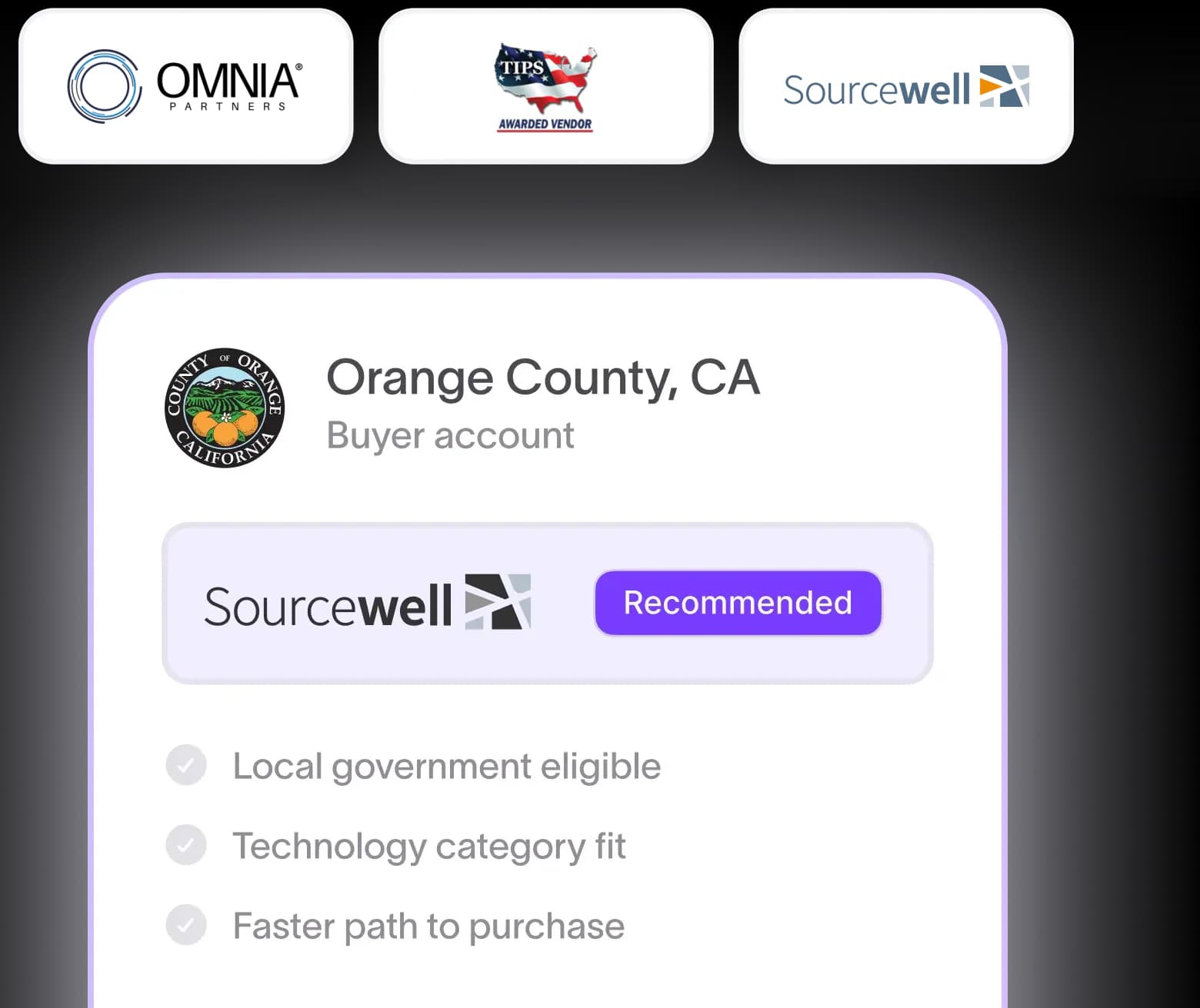
Vehicles include NASPO ValuePoint, OMNIA Partners, Sourcewell, TIPS, GSA, and other major cooperative contracts. Eligible state and local buyers, including public schools, can use GSA Cooperative Purchasing for eligible IT, security, and law-enforcement products and services on participating Multiple Award Schedule contracts.
Win the RFP before you write it
Starbridge is the AI GTM platform built on the most comprehensive dataset of public-sector buyers and buying signals. It helps companies selling to state and local government, K–12, and higher education identify, prioritize, and engage high-intent opportunities before the competition.

Book a demo to see how acting on buying signals and the right RFPs earlier helps your team win more deals.
Frequently asked questions
The buyer sets the response window, and the deadline stays binding unless an official amendment changes it. Plan backward from the due date, with the go/no-go call in the first two days and submission a day or more early. A reusable content library and AI drafting cut the hours each response takes.
An RFI gathers information while the buyer is still researching. An RFP asks vendors to propose a solution and price, with proposals scored on several criteria. An RFQ usually requests quotations for a defined purchase, but some buyers use the acronym for a request for qualifications.
Many solicitations restrict contact to the named procurement officer until the award, and violations can disqualify a bid. Check the solicitation for its cone-of-silence rules. Do your relationship work before release.
In states like Virginia, awarded proposals are open to public inspection after award, so you can request them through your state’s open records law. Response times vary by agency and state, and trade secrets can be redacted. Ask the procurement office first, since some buyers post award files online.
A non-compliant response is usually disqualified before scoring, no matter how strong the content. Common causes include missing forms, unacknowledged addenda, and late delivery. A compliance checklist with one owner prevents most of these misses.
Explore our use case library
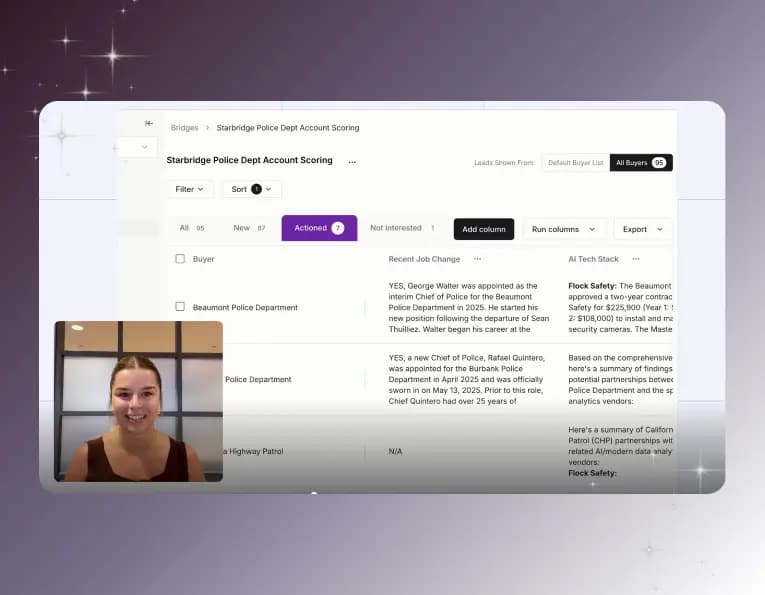 Automate account research with AI agentsStop manually researching accounts. Starbridge AI agents automate account research by monitoring buying signals 24/7 and surfacing the right contacts.
 Identify competitor contract expiration datesThe RFP is usually a formality. Starbridge surfaces competitor contract expiration dates so your reps reach accounts before the renewal cycle closes.
 Create a conference campaignTurn conference badge scans into pipeline. Import your contact list, surface buying signals across every account you met, and follow up with context.